Required personal data processing consents are displayed to new users during Teepee account registration via the registration form.
Each new user must agree to data processing before completing their registration — the account will only be created after all required consents are confirmed.
Available types in the GDPR tab
-
Consents – standard GDPR consents that can be granted or revoked.
For mandatory consents, specific rules apply when revoking them (see the information above). -
Declarations – the user or another authorized person confirms that they have read and understood the content of a declaration (e.g., internal policy, data handling notice).
Reading a declaration cannot be revoked.
ℹ️ Note: Declarations serve only as an acknowledgment of reading and understanding information; they do not represent consent in the GDPR sense.
Revoking consent and its consequences
If a person logged into the system (or another user with appropriate permissions who can edit the person’s GDPR tab) revokes a mandatory GDPR consent, the system automatically performs the following actions:
-
terminates the person’s membership in the organization,
-
blocks their Teepee account.
Membership termination applies not only to the specific unit where the person was a member but also to all their roles, functions, and memberships across the entire organization.
⚠️ Warning:
Once a mandatory consent is revoked, the user cannot access the Teepee system until a new valid consent for personal data processing is granted.
All the Consents are displayed in a person's Profile / GDPR tab.
⚠️ Warning:
Users who are younger than the defined minimum system age are not authorized to give GDPR consents on their own.In such cases, consents may be granted by their legal guardian or another authorized person (e.g., a unit administrator) according to the organization’s configured rules.
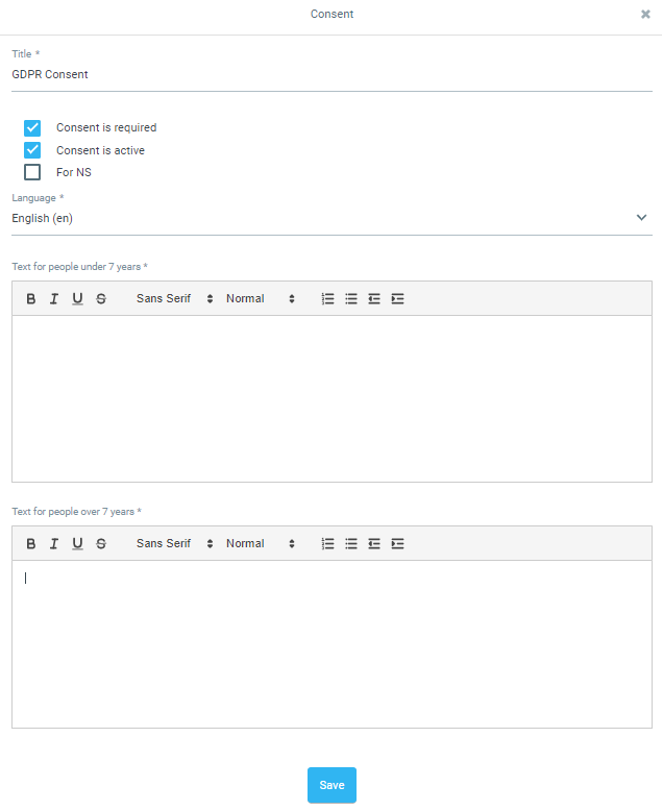
Form for creating or editing a consent
The form contains the following fields:
-
Name – the title of the consent, displayed in the registration form and in the user profile.
-
Language – select the language in which the consent will be shown. Ensure the content matches your system’s supported language versions.
-
Consent is mandatory – when activated, this consent is required from users or their legal guardians.
-
Consent is active for users younger than the minimum system age – when activated, the consent is displayed to users younger than the minimum system age. The consent record will be visible in the user’s GDPR tab.
-
Consent is active for users older than the minimum system age – when activated, the consent is displayed to users equal to or older than the minimum system age. The consent record will be visible in the GDPR tab.
-
Define custom age – allows you to set a custom age limit for displaying the consent. This custom age will replace the minimum system age for that consent.
-
Text for users younger than XX years – message displayed to users younger than the configured minimum (or custom) age.
-
Text for users older than XX years – message displayed to users who have reached or exceeded the configured minimum (or custom) age.
-
Consent for people with disabilities (ZŤP users) – this type of consent is intended for users with a disability status = YES and is visible only to those users.
💡 Tip: If your organization uses multiple language versions, prepare separate text versions of each consent to ensure they display correctly based on user language settings.
Then click Save.
Automatic notification when a user reaches the defined age
If a person who has been shown or granted consents intended for users younger than the minimum system age or a custom-defined minimum age reaches that age (system or custom), and has a contact email in their profile, the system automatically sends an informational email.
This email includes:
an overview of the consents previously granted to the person,
and information that the wording of these consents changes upon reaching the defined age.
An exception applies to consents that were defined exclusively for users younger than the minimum or custom-defined age — these consents no longer apply once the person reaches that age.